In the world of modern medicine, power reliability is not just a technical requirement—it is a matter of life and death. Whether in an intensive care unit, an operating theater, or a patient’s home, critical medical devices rely on a stable and clean power supply to function accurately and safely. A momentary dip in voltage, a transient spike, or an unstable current can lead to misdiagnosis, therapy failure, or even fatal outcomes.
While nearly all medical equipment depends on electricity, some devices demand exceptionally stable, low-noise, and medically certified power supplies due to their sensitivity, direct patient contact, or critical roles in sustaining life.
1. Ventilators Power supply: Powering Life-Sustaining Respiratory Support
Why stability is critical:
Mechanical ventilators provide respiratory assistance to patients who cannot breathe effectively on their own due to illness, surgery, or trauma. During the COVID-19 pandemic, the role of ventilators in intensive care units (ICUs) became globally recognized.
Power supply demands:
Continuous operation 24/7
Real-time control of air flow, pressure, and oxygen delivery
Low EMI to prevent interference with other ICU equipment
Redundant or backup systems to ensure uninterrupted function
Failure consequences:
Loss of ventilation can lead to hypoxia, brain damage, or cardiac arrest within minutes.
Power supply features to prioritize:
Medical-grade certification (IEC 60601-1)
Dual-output or battery backup integration
2 x MOPP insulation
Low leakage current (<100 µA)
2. Patient Monitors Power supply: Reliable Data for Real-Time Decision Making
Why stability is critical:
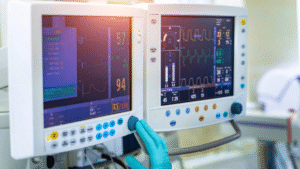
Patient monitors continuously track vital signs—ECG, blood pressure, oxygen saturation, respiratory rate, and temperature. Any distortion or dropout in the power supply can result in false alarms, missed readings, or erroneous data interpretation.
Power supply demands:
Low ripple noise and precise voltage regulation
Support for sensitive analog and digital circuits
Compliance with EMC standards (IEC 60601-1-2)
Long operational life and low thermal signature
Failure consequences:
False readings may lead to delayed treatment or incorrect clinical decisions, especially in emergency or surgery settings.
Key design considerations:
Use of linear regulators or switching power supplies with effective filtering
Input voltage tolerance for portable monitors
Hot-swappable backup options
3. Infusion Pumps Power supply: Precision Dosing Requires Precision Power
Why stability is critical:
Infusion pumps deliver precise volumes of fluids—such as medication, nutrients, or insulin—directly into the bloodstream. Their operation must be precise, programmable, and fail-safe.
Power supply demands:
High accuracy and tight voltage tolerance
Protection from voltage surges and brownouts
Compatibility with battery systems for portable or ambulatory use
Class II isolation for home and bedside safety
Failure consequences:
Overdose or underdose of medication
Risk of embolism or fluid imbalance
Device malfunction during patient mobility
Power solution strategies:
Integration of AC-DC power adapters with battery charging circuits
Use of medically certified external adapters for easy global compliance
Leakage current protection in line with CF-type requirements
4. Diagnostic Imaging Equipment (Ultrasound, MRI, CT) Power supply: Clean Power for Clean Imaging
Why stability is critical:
Diagnostic imaging equipment such as ultrasound machines, MRI scanners, and CT systems rely on high-frequency signals and digital processing. Stable power ensures accurate image acquisition, processing, and display.
Power supply demands:
Low noise and interference to prevent image artifacts
High current capacity for imaging subsystems
Multi-output regulation for analog/digital circuits
Compliance with EMI/EMC requirements in radiology departments
Failure consequences:
Blurred or misleading images
Need for repeat scans, increasing patient radiation exposure
Misdiagnosis due to corrupted data
Ideal power supply features:
Medical-grade open-frame or modular supplies with isolated outputs
Filters to suppress conducted and radiated EMI
Smart power control for energy efficiency and system protection
5. Home-Use Medical Devices (CPAP, Breast Pumps, TENS Units) Power supply
Why stability is critical:
As healthcare shifts from hospitals to homes, medical devices such as CPAP machines, breast pumps, and TENS units must function safely and reliably in non-clinical environments. Unlike controlled hospital settings, home use introduces variables like poor power quality, user error, and environmental factors.
Power supply demands:
Compact and fanless operation for patient comfort
Universal input voltage (90–264VAC) for global use
Robust insulation and ingress protection (IEC 60601-1-11)
Energy-efficient and quiet operation
Failure consequences:
Disruption in therapy (e.g., sleep apnea events from CPAP failure)
Inadequate treatment compliance
Safety hazards from overheating or electrical faults
Key considerations:
Medical adapters must be Class II with reinforced insulation
Leakage current <75μA for patient-contact devices
Integrated overcurrent, overvoltage, and short-circuit protection
Common Power Supply Design Requirements Across These Devices
While each of these top 5 devices has unique demands, they share common requirements that define medical-grade power:
| Requirement | Purpose |
| IEC 60601-1 Certification | Ensures electrical safety and patient protection |
| Low Leakage Current | Prevents electrical shock (especially for CF devices) |
| 2 x MOPP Insulation | Protects patients and users from fault conditions |
| EMC Compliance (IEC 60601-1-2) | Avoids EMI-related malfunctions |
| Power Redundancy & Backup | Ensures uninterrupted operation during power loss |
| Compact, Fanless Designs | Enhances usability in portable and home applications |
The Role of Reliable Medical Power Supply Manufacturers
Choosing a power supply isn’t just a matter of selecting the right wattage. It requires working with suppliers who:
Understand medical certification (IEC 60601-1, CB, CE, UL, FCC)
Offer long lifecycle support and change notification
Use ISO 13485-certified manufacturing processes
Provide customization for OEM integration
Quankang, for instance, delivers a wide range of IEC 60601-1 certified medical power adapters and open-frame power modules, ideal for ventilators, monitors, infusion systems, and home medical devices. With ultra-low leakage current, 2 x MOPP insulation, and global regulatory approvals, Quankang ensures that your devices run safely—whether in a surgical suite or someone’s bedroom.
Conclusion: Power Stability Is Patient Safety
As medical devices grow more connected, mobile, and precise, the need for stable, certified, and reliable power supplies has never been greater. From life-sustaining ventilators to home-use therapeutic tools, power failure is not an option. Engineers, medical OEMs, and device integrators must prioritize certified medical grade power supply solutions in their designs to meet today’s regulatory and clinical expectations.
When power stability supports patient stability, your device isn’t just functioning—it’s saving lives.