A Complete POE Adapter Selection Guide for IP Camera, Access Point, IoT, and More
Choosing the right POE Power Adapter is essential to ensure efficient, safe, and stable power delivery to IP cameras, wireless access points, VoIP phones, IoT devices, and other networked equipment. A mismatched POE adapter may cause issues such as insufficient power, unstable connectivity, overvoltage damage, or even device failure. This POE adapter selection guide explains how to choose POE power adapters based on voltage, power grades, POE standards, cable length, and environmental application requirements.
Whether you’re implementing a surveillance system, deploying WiFi networks, or integrating smart building solutions, selecting the correct POE power adapter is critical for both device performance and long-term reliability.

1. Why POE Adapter Selection Matters
Unlike ordinary power adapters, a POE adapter delivers both power and data through a single Ethernet cable. This eliminates the need for separate power wiring and simplifies deployment, especially in ceilings, poles, outdoor walls, or remote locations.
However, choosing the wrong POE adapter can lead to:
Device not powering up
Power restarting intermittently
Overcurrent damage to equipment
Poor signal transmission or network instability
System safety hazards (overheating, fire, or electrical risk)
A professional POE adapter selection guide helps you ensure compatibility, safety, and efficiency, especially for mission-critical devices like IP surveillance cameras, Access Points, and networking equipment.
2. Analyze Power Requirements of the Load Device (IP Cameras, Access Points, IoT)
Understanding your device’s power demand (Watts) is the foundation of POE adapter selection.
| Device Type | Typical Power Consumption |
| Basic IP Camera | 5–10W |
| PTZ / 4K Zoom Camera | 15–30W |
| Wi-Fi Access Point | 10–20W |
| VoIP Phone | 5–12W |
| Smart IoT Gateway | 15–25W |
| Industrial Controller / PLC | 20–60W |
Tip: Always select a POE power adapter with 20% higher wattage than the device’s rated consumption for safety and performance stability.
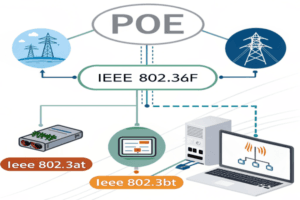
3. Match POE Standards with Power Output (802.3af / 802.3at / 802.3bt)
POE technology follows three main IEEE standards:
| Standard | Max Power Supplied (To Device) | Typical Use |
| 802.3af (POE) | 12.95W | Basic IP cameras, VoIP phones |
| 802.3at (POE+) | 25.5W | Access Points, PTZ Cameras |
| 802.3bt (POE++ Type 3/4) | 51W–90W | Industrial, high-power CCTV, smart devices |
If your IP Camera or WiFi AP consumes more than 13W, use 802.3at POE+.
High-power devices like PTZ cameras, dual-band APs, smart gateways, or industrial IoT controllers require 802.3bt POE++.
Choosing the wrong POE standard will result in insufficient power, leading to poor device stability.
Want to understand full POE technology? See: POE Power Adapter Complete Guide
4. Voltage, Current, and Cable Length Selection (12V / 24V / 48V POE Adapter)
POE adapter output voltages commonly include: 12V, 24V, and 48V.
Choosing the correct voltage is essential for safety and compatibility.
| Adapter Type | Best Use Scenario |
| 12V POE Adapter | CPE routers, LED signage, mini CCTV, IoT hubs |
| 24V Passive POE | Wireless AP (Ubiquiti, MikroTik), outdoor CPE |
| 48V Active POE (802.3af/at/bt) | IP cameras, Access Points, VoIP, IoT systems |
Cable Length & Power Loss Formula
Voltage drop increases over long distances. Use this formula to assess Ethernet cable loss:
Power Loss (W) ≈ Current² × Cable Resistance × Cable Length
To minimize loss, choose:
Higher voltage (48V) for long-distance transmission
CAT6 or CAT6A cables for distances up to 100 meters
Shielded cable (STP) for outdoor/interference environments
Need help with long-distance POE setup? Learn more in: POE Installation & Troubleshooting Guide
5. Why Surge, Overcurrent, and Overvoltage Protection Matter
Safety is particularly critical in outdoor or 24/7 operation environments such as:
Highway surveillance
Industrial factories
5G base stations
Smart pole systems
Make sure your POE Adapter includes:
| Protection Feature | Benefit |
| Overvoltage Protection (OVP) | Prevents burning sensitive circuits |
| Overcurrent Protection (OCP) | Avoids system overload |
| Short Circuit Protection (SCP) | Prevents equipment damage |
| Surge / Lightning Protection | Ensures outdoor reliability |
| EMI / EMC Shielding | Avoids signal interference |
Professional-grade POE adapters, like those from Quankang, are designed with full-level protection for both indoor and outdoor deployment.
6. Industry-Specific POE Adapter Selection Recommendations
| Application Area | Recommended POE Standard | Notes |
| IP Surveillance (CCTV) | 802.3at / bt | PTZ cameras, infrared night vision require higher power |
| WiFi Coverage (Access Point) | 802.3at | Dual-band and mesh routers may need 25–30W |
| Smart Home / IoT | Passive 24V / 48V | Smart gateways, sensors, voice control |
| Industrial Automation / PLC | 802.3bt | High reliability, wide temperature range |
| Smart City Systems | 802.3bt | Traffic monitoring, smart lighting, parking systems |
Want to explore POE in IoT, CCTV, and Smart Building applications?
Check supporting article: POE Power Adapter Applications in IP Surveillance & IoT
7. Recommended: Quankang POE Adapter Series
Quankang provides professional POE Power Supply Solutions designed for security monitoring, wireless access points, industrial control systems, and commercial network products.
Quankang POE Adapter Features
Supports IEEE 802.3af/at/bt standards
Available in 12V, 24V, and 48V power outputs
Full safety protection: OVP, OCP, SCP, surge protection
Low ripple, high efficiency (up to 92%)
CE, FCC, UL, RoHS certified for global compliance
OEM/ODM customization for system integrators & device manufacturers
Popular Models:
Quankang 48V 0.5A POE Adapter (802.3af)
Quankang 48V 1.2A High-Power POE+ (802.3at)
Quankang 48V 2.0A Industrial Grade (802.3bt 90W)
Quankang 24V POE Passive Router Injector
Quankang Outdoor Waterproof POE Power Supply
Conclusion
Choosing the right POE power adapter depends on four key factors:
Device power consumption and application environment
Matching IEEE POE standards (af / at / bt)
Correct voltage (12V / 24V / 48V) and cable length
Safety protection, certifications, and reliability
By following this POE adapter selection guide, you can ensure that your IP Cameras, Access Points, and IoT devices stay powered safely, efficiently, and continuously.
For stable, certified, and custom-built POE power solutions—
Quankang is your trusted partner in POE Adapter manufacturing.