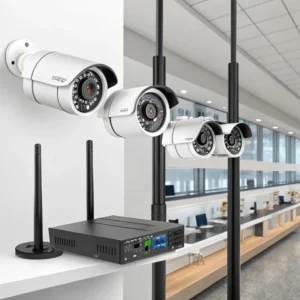
In today’s ever-evolving network technology landscape, Power over Ethernet (PoE) has become a critical infrastructure for smart buildings, security monitoring, enterprise offices, and IoT applications. More and more devices rely on a single network cable for data transmission and power supply, reducing complex power cabling, lowering maintenance costs, and enhancing overall network flexibility and scalability. However, PoE technology is not a single specification; it is defined by a series of IEEE standards, including 802.3af, 802.3at, and 802.3bt. Different standards correspond to different power supply capabilities, applicable devices, and design philosophies. With the widespread deployment of modern PoE routers in various environments, understanding these PoE standards is crucial for building highly reliable network architectures. Therefore, a thorough understanding of PoE specifications, from basic power supply to high-power expansion, from device compatibility to future trends, is invaluable for network administrators, system integrators, and even ordinary consumers.
The core concept of PoE technology lies in enabling Ethernet cables to simultaneously handle power supply (DC power) and data transmission. This requires two key components: the power-providing end is called the PSE (Power Sourcing Equipment), represented by devices such as PoE routers, PoE switches, and PoE injectors; the power-receiving device on the other end is called the PD (Powered Device), such as network cameras, wireless access points, VoIP phones, smart access control systems, and IoT sensors. Before the power supply begins, the PSE and PD undergo a standardized “detection and classification” process to ensure the other device supports PoE and confirm the required power level before the system is truly powered on. This not only ensures security but also prevents damage to ordinary network devices that do not support PoE. Because of this intelligent negotiation mechanism, modern PoE routers can automatically identify device needs and flexibly allocate power, thereby achieving more efficient and secure network power management.

Of all PoE standards, IEEE 802.3af was the first to be marketed and widely adopted, laying the foundation for subsequent standards. The 802.3af standard offers a maximum power delivery of 15.4W (port output), which, after cable losses, delivers approximately 12.95W to the device. This power level is sufficient for many lightweight applications, such as standard network cameras, basic wireless access points (APs), VoIP phones, access control card readers, and some low-power sensors, making it widely used in small to medium-sized office environments and home networks. The advent of 802.3af revolutionized traditional network cabling, allowing a single PoE router to provide stable power to multiple devices, reducing reliance on adapters and sockets. However, with the rapid improvement in device performance, the 12.95W power delivery capability gradually became insufficient for high-demand scenarios such as high-definition cameras, multi-antenna wireless APs, or outdoor devices with night vision lighting, thus prompting the development of the next-generation standard.
Therefore, IEEE introduced the 802.3at standard, also known as PoE+. PoE+ nearly doubles the power delivery capability, with port output power reaching 30W, and the device actually receiving approximately 25.5W. Models like PoE35-XXA and PoE35-560062SPA are particularly well-suited for this upgrade, enabling PoE technology to support a wider range of modern devices, including high-resolution cameras, dual-band or tri-band wireless access points, PTZ cameras with rotating capabilities, outdoor surveillance equipment with heating modules, and more mid-power IoT applications. 802.3at is arguably the most common PoE standard in commercial environments today, with most enterprise Wi-Fi deployments, commercial surveillance systems, and smart access control devices relying on PoE+ power. Its widespread adoption makes network construction more flexible, especially in locations where cabling is inconvenient, such as ceilings, high walls, or outdoors. With the evolution of wireless standards from Wi-Fi 5 to Wi-Fi 6 and then to Wi-Fi 7, 802.3at has become almost an indispensable foundational standard for modern networks.

However, as technology continues to develop, the market demand for higher power becomes inevitable. Machine vision cameras, AI algorithm cameras, multi-sensor integrated monitoring equipment, brighter digital signage, and high-power Wi-Fi 6/7 access points all require power supplies exceeding 25W. To meet these demands, the IEEE standard was further upgraded to 802.3bt, commonly known as PoE++ or Ultra PoE. 802.3bt introduces two power levels: Type 3 supports up to 60W, while Type 4 breaks through this barrier by supporting 90W–100W. This high power allows PoE to be applied to devices that previously required independent power supplies, such as high-end AI PTZ cameras, 4K/8K high-definition multi-lens cameras, outdoor intelligent lighting systems, building automation controllers, ultra-high-power wireless access points, small industrial control computers, and higher-load intelligent terminals. 802.3bt is considered a crucial cornerstone for future smart buildings and the Industrial Internet of Things (IIoT), symbolizing PoE technology’s entry into the “high-power era.”
Beyond the PoE standard itself, understanding “power budget” is equally important when choosing a PoE router. Power budget refers to the total power supply capacity of all ports on a PoE router. For example, an 8-port PoE router might have each port support 30W output, but its total power budget might only be 120W. This means that when multiple high-power devices are connected to the ports simultaneously, the actual power supply capacity will be limited. If each device requires 25W, then it can only stably support a maximum of four to five devices. Insufficient power budget can lead to problems such as automatic power loss, restarts, screen interruptions, and infrared lights failing to activate at night. Therefore, in actual deployment, both port power (maximum output per port) and the overall power budget must be considered, with a certain margin reserved to avoid limitations on future expansion. For system integrators, properly planning the power budget of a PoE router is often more important than choosing the number of ports.
Compatibility is also an indispensable factor when purchasing modern PoE routers. Because IEEE standards have excellent backward compatibility, for example, devices supporting 802.3bt are compatible with both AT and AF, and PoE+ devices are also compatible with AF. The system will automatically allocate appropriate power based on the PD’s capabilities. The reverse is not true; for example, a camera requiring 25W will not work stably if connected to a port that only supports AF. This compatibility design makes network construction safer and upgrades easier. When installing PoE devices, understanding the compatibility relationships between standards can help avoid configuration errors and prevent device instability or even damage due to an insufficient power supply.
From an overall application perspective, high-standard PoE brings many practical deployment advantages. First, it greatly simplifies network cabling; only one network cable is needed for power supply and data transmission, significantly reducing construction time and cabling costs, and making the cabling environment cleaner. Second, high-standard PoE allows for more flexible device deployment, eliminating the need to find power outlets in specific locations, which is especially significant for locations such as ceilings, outdoors, elevator lobbies, and warehouses. Furthermore, centralized power supply, coupled with UPS, provides unified power outage protection, ensuring that monitoring or wireless networks continue to operate during power outages—an advantage difficult to achieve with traditional independent power supplies. Finally, choosing a high-standard PoE improves network scalability. As network devices upgrade over time, a PoE router supporting at or BT ensures seamless future device integration, reducing the overall architecture’s lifecycle cost.
Different scenarios have different PoE requirements. In homes or small offices, 802.3af and 802.3at are usually sufficient for most cameras, access points (APs), and smart devices. For environments like cafes, small shops, or retail stores, PoE+ is the most common option, supporting multiple wireless APs and multiple surveillance cameras simultaneously. For large enterprises, warehouses, or campus networks, a combination of PoE+ and PoE++ is necessary, especially when using high-performance APs, PTZ cameras, or industrial sensors. For large-scale outdoor security deployments, smart street lighting systems, AI camera systems, and building automation centers, the 802.3bt solution is often the first choice to ensure stable high-power output even under long-distance transmission and multiple devices coexisting. Correctly selecting the PoE standard not only affects the performance stability of the devices but also the long-term maintenance costs and scalability of the entire network system.
With the continuous increase in smart terminals and the widespread adoption of IoT technology, the future development prospects of PoE technology are even broader. Looking at the trends, high-power PoE will continue to expand, and higher-level power supply standards may emerge in the future to meet the higher power consumption demands of smart displays, high-performance AI terminals, building energy systems, or small computing devices. At the same time, intelligent power management technology will be further integrated into PoE systems, helping administrators monitor power distribution in real time, remotely control device power supply, improve fault diagnosis capabilities, and optimize energy efficiency. Furthermore, the combination of PoE and renewable energy systems is also considered an important trend in future smart buildings. Through centralized power management, PoE networks can utilize solar energy, battery storage, or regional energy systems more efficiently to achieve a greener and more economical energy structure. With the development of smart cities, PoE will be more than just a network power supply tool; it will be a key component in building a unified power data platform.

In summary, a deep understanding of the PoE 802.3af, 802.3at, and 802.3bt standards is crucial for planning or deploying modern PoE routers. Standards not only determine the power levels available to devices but also affect device stability, future upgrade flexibility, and overall network security. Choosing the wrong PoE standard can lead to insufficient power, frequent device disconnections, or degraded system performance, while choosing the right standard can build a more stable, simpler, and more scalable network architecture. Whether you’re using surveillance cameras, wireless access points, information displays, or smart sensors, understanding the significance of PoE standards, power budget concepts, and compatibility principles is key to ensuring smooth network operation. As network devices continue to upgrade, PoE will continue to be a core technology for intelligent infrastructure, and choosing the right PoE router is the first step in building a modern network.