In intelligent public and commercial spaces, small information display screens have become an important medium for information transmission. Whether at the entrance of conference rooms, in hospital corridors, in shopping mall wayfinding systems, or on school bulletin boards, these compact screens display information most intuitively. Despite their small size, they bear a crucial communication function. However, for installers and system integrators, a persistent practical problem is: how can these screens be powered and wired more conveniently?
Traditional power supply methods require separate power and network cables for each information display screen. Wall sockets must be reserved, and power adapters are scattered in various corners, resulting in a large amount of wiring work and significant maintenance difficulties. Especially when there are many screens, the messy cables not only affect the aesthetics of the space but also complicate system expansion and maintenance. This cumbersome wiring method is incompatible with the “simple and efficient” concept of modern intelligent spaces.
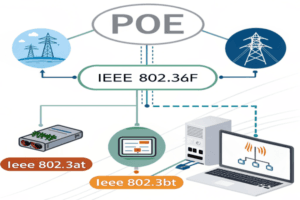
The widespread adoption of PoE (Power over Ethernet) technology has brought a smarter solution to these problems. PoE can transmit data and power simultaneously through a single network cable, eliminating the need for separate power cords for devices. For small information display screens, this means simpler installation, requiring only a single network cable for connection and power. No additional sockets, no complex cabling, and no space constraints.
In a PoE system, the PoE adapter (also called a PoE injector) plays a highly flexible role. It transforms a regular network connection into a powered network, providing a stable power output for small information screens, doorplate displays, digital signage, and other devices. For users already using standard switches, the PoE adapter can be directly upgraded to their existing system without replacing network equipment. Simply plugging the PoE adapter between the data cable and the terminal provides immediate power to each display screen.

These adapters typically output 48V DC, conforming to IEEE 802.3af or 802.3at standards, with a maximum output power of 15.4W or 25.5W. This perfectly matches the typical power consumption of small information display screens, which is generally between 5W and 15W, well within the PoE power supply range. This matching not only improves power efficiency but also reduces energy loss. More importantly, high-quality PoE adapters typically feature safety designs such as overvoltage, overcurrent, and short-circuit protection, ensuring stability during long-term operation and preventing screen flickering or device damage.
The advantages of PoE extend beyond its technical aspects, manifesting in the ease of installation and management. Take conference room signage as an example: previously, each screen required a power cable to be run from the ceiling and connected to a socket. With a PoE adapter, only one network cable is needed from the switch to the screen, transmitting data and simultaneously powering the screen. For companies deploying multiple displays, this translates to a reduction in cabling by more than half, a shorter construction period, and more intuitive maintenance.
In locations like hospitals and schools, another significant benefit of PoE power supply is safety. Because PoE uses low-voltage DC power, it eliminates the need for high-voltage power lines, reducing the risk of electric shock and avoiding the safety hazards of exposed wall sockets. Neat cabling enhances the aesthetics of the environment and facilitates future system expansion and relocation.

In factories and production lines, PoE adapters demonstrate industrial-grade stability. Production line information screens require continuous operation for extended periods and are typically located in environments with high levels of interference. PoE adapters’ centralized power supply effectively reduces wiring points and improves system stability. When production lines need expansion, only a few more PoE ports need to be added, eliminating the need for additional power cabling and making overall deployment more flexible.
For retail and shopping mall scenarios, PoE’s advantages are equally evident. Wayfinding screens, electronic shelf signs, and advertising displays in shopping malls are typically geographically dispersed, and their installation environments frequently change. PoE power supply allows these terminals to be repositioned at any time; only rewiring the network cables is required, eliminating the limitations imposed by socket distribution. Fewer cables mean a cleaner visual aesthetic and a more modern overall design.
Choosing a high-quality PoE adapter is crucial for the stable operation of the entire system. A reliable PoE adapter not only needs sufficient output power and electrical protection but should also pass relevant safety and EMC certifications to ensure reliability in various environments. For long-running information display systems, this stability directly determines whether the screen can remain lit continuously and whether the system can communicate stably.
Besides simplifying cabling and improving security, PoE technology also brings new possibilities for energy management. Through a PoE system, administrators can monitor the power consumption of each display screen in real time from the backend and achieve remote control, such as scheduled power on/off or abnormal restarts. This centralized management method greatly improves operational efficiency and meets the energy efficiency requirements of smart buildings and IoT systems.
Today, PoE power supply is no longer exclusive to network devices. It is becoming an indispensable part of smart displays, building automation, and education and healthcare information systems. Through PoE adapters, small information display screens achieve true “one-wire power supply,” making installation easier, spaces cleaner, and management smarter.
In the future, as the power consumption of display devices further decreases and network architecture continues to optimize, the application scenarios of PoE will continue to expand. From conference rooms to hospitals, from factories to shopping malls, this technology is quietly reshaping the fundamental logic of information display systems. Through a single network cable, it not only transmits data but also illuminates new ways of information dissemination.