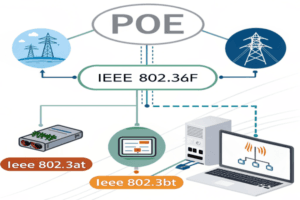
In today’s information age, people cannot live without network communication, so the use of PoE power, short for Power Over Ethernet, is becoming increasingly widespread.
The principle of PoE power is actually quite simple: it allows power and data to be transmitted through the same network cable, eliminating the need for separate power cables for each device. This means that as long as there is a network cable, data transmission and power supply can be performed simultaneously. However, what truly made PoE an industry standard and widely adopted were a series of standardized specifications from IEEE—802.3af, 802.3at, and 802.3bt. These specifications define power levels, power supply methods, and negotiation mechanisms, ensuring compatibility and security between different brands and devices. Now, more and more industrial IoT devices are adopting PoE power supply, such as IP phones, network video surveillance, and wireless Ethernet devices.
IEEE 802.3af: The Starting Point of PoE
The standardization history of PoE began in 2003 when IEEE officially released the 802.3af standard, also known as Type 1.
It defined a maximum power supply of 15.4W from the Power Supply Equipment (PSE) to the Power Receiver (PD), with approximately 12.95W actually usable by the device. The voltage range was between 44 and 57V, and the current was transmitted through two pairs of network cables.
At the time, this power level was sufficient for low-power devices such as IP phones, basic network cameras, and access control card readers. 802.3af freed these devices from the constraints of external power supplies, greatly simplifying network deployment complexity.
For engineers, it represented a more flexible and controllable system architecture. However, as network devices began to undertake more computing and imaging tasks, the 15W power limit quickly became insufficient; thus, the second-generation standard was born.

IEEE 802.3at: The Emergence of PoE+
In 2009, IEEE released the 802.3at standard, commonly referred to in the industry as PoE+ (Type 2).
This generation of the standard increased the maximum output power to 30W. For example, the PoE35-XXA can achieve 25.5W of effective power on the PD side, and it is fully backward compatible with 802.3af.
Technically, 802.3at allows for higher current transmission, improves device detection and classification mechanisms, and optimizes power negotiation and security protection.
This allows PoE to support more high-power terminals, such as PTZ surveillance cameras with pan-tilt-zoom capabilities, video conferencing terminals, and higher-performance Wi-Fi access points (APs).
If 802.3af made network devices “accessible,” then 802.3at makes more complex devices “powered effectively.”
This is not just about doubling power; more importantly, it’s about a comprehensive improvement in power supply stability, device identification, and system security.

IEEE 802.3bt: Entering the High-Power Era
PoE truly entered the “high-power” era after the official release of the IEEE 802.3bt standard in 2018.
It brought two key innovations: support for four-pair power delivery and the introduction of two higher power levels, Type 3 and Type 4.
Under this standard, the maximum output power of the PSE can reach 60W (Type 3) or even 90~100W (Type 4), such as PoE90-560161 and PoE100-54A, while the device side can achieve an effective power of up to 71~90W.
This allows PoE to support more high-load devices, such as:
Wi-Fi 6 / Wi-Fi 6E wireless access points
High-performance PTZ cameras
Digital signage and information displays
802.3bt also added power levels Class 5 to Class 8 and introduced the Autoclass dynamic power negotiation mechanism.
This allows the system to intelligently identify the actual needs of the powered devices, thereby achieving higher energy efficiency and lower heat loss.
Core Comparison of Three Generation Standards
| Standard | Alias | Type | PSE Maximum Output | PD Available Power | Number of Wire Pairs | Typical Applications |
|---|---|---|---|---|---|---|
| IEEE 802.3af | POE | Type 1 | 15.4W | 12.95W | 2 pairs | IP phones, basic cameras |
| IEEE 802.3at | POE+ | Type 2 | 30W | 25.5W | 2 pairs | PTZ cameras, Wi-Fi APs |
| IEEE 802.3bt | POE++ | Type 3/4 | 60W / 90W | 51W / 71~90W | 4 pairs | Wi-Fi 6 APs, industrial computers, digital signage |
This table clearly shows that each generation of standards has consistently advanced in terms of power, number of power supply pairs, and applications.
From its initial use in voice and monitoring to today’s AIoT and smart buildings, PoE is becoming the core infrastructure for “energy and data fusion.”
Challenges of PoE Power Supply Design
As power output increases, so does the complexity of PoE power supply design.
In high-power (e.g., 90W) systems, the most common issues include cable loss, heat generation, EMI (electromagnetic interference), and safety isolation requirements.
For example, every 10-meter increase in cable length can result in a 2-3% power loss. This means that if the power conversion efficiency is insufficient, end devices may experience power outages or instability.
Therefore, when designing high-power PoE power supply modules, engineers must balance conversion efficiency with thermal management.
Technologies such as synchronous rectification, active PFC (Power Factor Correction), intelligent current limiting protection, and overvoltage protection are crucial for the reliable operation of PoE power supplies.

How to Choose the Right PoE Power Supply Solution
In actual projects, choosing the right PoE power supply solution often determines the stability of the system.
First, it’s essential to determine: what type of device (PD) are you using?
Is it a standard Type 1 device (such as a voice phone), or a Type 3/4 device requiring higher power (such as a Wi-Fi 6 access point)?
Secondly, the selection should be based on the type of Power Supply Adapter (PSE):
For PoE switches, a built-in modular power supply can be used.
For traditional switches, an external PoE Injector or Midspan module can be used.
Attention should also be paid to certification standards, such as UL, CE, FCC, IEC62368, and even medical-grade IEC60601.
For industrial or outdoor applications, operating temperature range, surge protection, and long-term load stability must also be considered.
In enterprise network or smart building projects, choosing a high-efficiency, stable, IEEE-compliant PoE power supply not only means less installation work but also lower maintenance costs and higher system reliability.
Conclusion: The Future of PoE

From 15W to 90W, each evolution of PoE signifies new possibilities.
It allows smart devices to be “plug and play” anywhere, blurring the lines between power and communication.
In rapidly growing fields such as smart cities, AIoT, healthcare, security, and industrial automation, PoE is gradually becoming an invisible infrastructure—robust, energy-efficient, and scalable. For power supply manufacturers and system integrators, understanding IEEE standards is not merely a technical requirement but a key to grasping future trends.
PoE is not an accessory, but a way of thinking—a way of enabling energy and data to flow together.