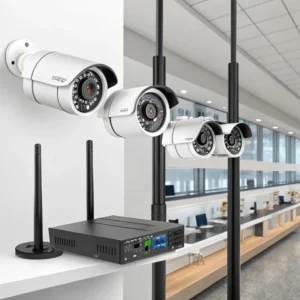
Power over Ethernet (PoE) has revolutionized how modern IP cameras, access points, smart building devices, and IoT systems are powered. However, not all PoE systems are the same. The IEEE POE standards — 802.3af, 802.3at, and 802.3bt — define different voltage, current, and power capabilities, and selecting the wrong one can lead to device failure, performance instability, or even safety hazards.
Understanding these PoE standards is critical for selecting compatible equipment, planning system deployment, and ensuring long-term reliability.

Why PoE Standards Matter for Device Compatibility
PoE is not just about delivering power — it’s about delivering the right power, safely and efficiently. Different devices require different wattages:
| Device Type | Typical Application | Power Requirement |
| Basic IP Camera | Office / Hallway monitoring | 5–10W |
| Wi-Fi Access Point | Small office, home | 8–15W |
| PTZ Camera | Public space surveillance | 20–30W |
| AI-IP Camera (4K Analytics) | Smart city, security analytics | 30–60W |
| Smart Lighting / Building BMS | Smart building automation | 30–90W |
| Industrial IoT Gateway | Smart factories, automation | 60–90W |
If the PoE adapter output power is lower than required, the device may restart, lose connection, or fail to function. If it’s too high, it may cause overheating or damage.
This is why knowing whether your device needs 802.3af, 802.3at (PoE+), or 802.3bt (PoE++) is essential.
Planning device selection? See POE Adapter Selection Guide
2.802.3af / 802.3at / 802.3bt: Voltage, Current & Power Comparison
| Standard | Power Name | Max Power at PSE | Max Power at PD | Voltage Range | Typical Applications |
| 802.3af | PoE | 15.4W | 12.95W | 44–57V | Basic IP cameras, VoIP phones, Wi-Fi AP |
| 802.3at | PoE+ | 30W | 25.5W | 50–57V | PTZ cameras, dual-band AP, smart door access |
| 802.3bt Type 3 | PoE++ | 60W | 51W | 50–57V | 4K AI cameras, LED displays, IoT controllers |
| 802.3bt Type 4 | PoE++ | 100W | 71W | 52–57V | Smart lighting, digital signs, industrial IoT |
Key Differences:
802.3af: Suitable for lightweight network devices like basic IP cameras and access points.
802.3at: Designed for higher power devices such as PTZ cameras and smart sensors.
802.3bt: Enables AI cameras, LED signage, and industrial automation with up to 100W.
3.Device Power Requirement Examples
| Device Type | Typical PoE Standard | Power Range |
| Office IP Phone | 802.3af | 5–7W |
| Basic IP Camera | 802.3af | 5–12W |
| Wi-Fi AP (dual-band) | 802.3at | 10–25W |
| PTZ Camera / Zoom | 802.3at / 802.3bt | 20–35W |
| 4K AI Smart Camera | 802.3bt | 30–60W |
| Smart Door Access Panel | 802.3at / bt | 15–40W |
| Industrial IoT Gateway | 802.3bt | 40–90W |
| Smart Lighting Display | 802.3bt | 30–90W |
Want to see application examples? Check POE Applications in IP Surveillance & IoT
4.Choosing the Right POE Adapter Based on Standard
| Requirement | Recommended POE Standard |
| VoIP phones, basic cameras | 802.3af PoE |
| Wi-Fi AP, mid-power CCTV | 802.3at PoE+ |
| PTZ, AI Cameras, LED Display | 802.3bt PoE++ |
| Industrial IoT, Heavy devices | 802.3bt Type 4 (90W) |
Selection Checklist
Check your device power requirements (label or datasheet)
Ensure POE adapter supports correct IEEE standard
Confirm voltage (12V / 24V / 48V) and max wattage
Consider cable length – >80m may require boosted PoE
Use surge protection for outdoor or industrial deployment
5.How Quankang Ensures Multi-Standard POE Compatibility
Quankang POE Power Adapters are engineered to provide high compatibility, safety, and reliability, supporting all IEEE PoE standards:
Quankang POE Adapter Key Features:
Full support for 802.3af / 802.3at / 802.3bt standards
Supports 12V, 24V, 48V, and 54V output options
Wide power range: 15W / 30W / 60W / 90W / 120W
Built-in over-voltage, over-current, ESD, and surge protection
Available for indoor, outdoor, and industrial-grade applications
Custom OEM/ODM and PoE injector + splitter solutions
Global certifications: CE, UL, FCC, RoHS
Conclusion
PoE standards — 802.3af, 802.3at, and 802.3bt — determine power capacity, safety, and device compatibility. Choosing the right PoE adapter depends on understanding your equipment’s voltage and wattage needs, as well as deployment environments.
When designing or upgrading a PoE system, always ensure:
Correct IEEE PoE standard
Proper voltage (12V / 24V / 48V) and wattage
Surge protection for outdoor use
Certification compliance and reliability
Quankang POE Power Adapter Series offers professional-grade, multi-standard compatible solutions for IP surveillance, IoT, smart homes, intelligent buildings, and industrial automation — ensuring safe, powerful, and reliable power delivery.